
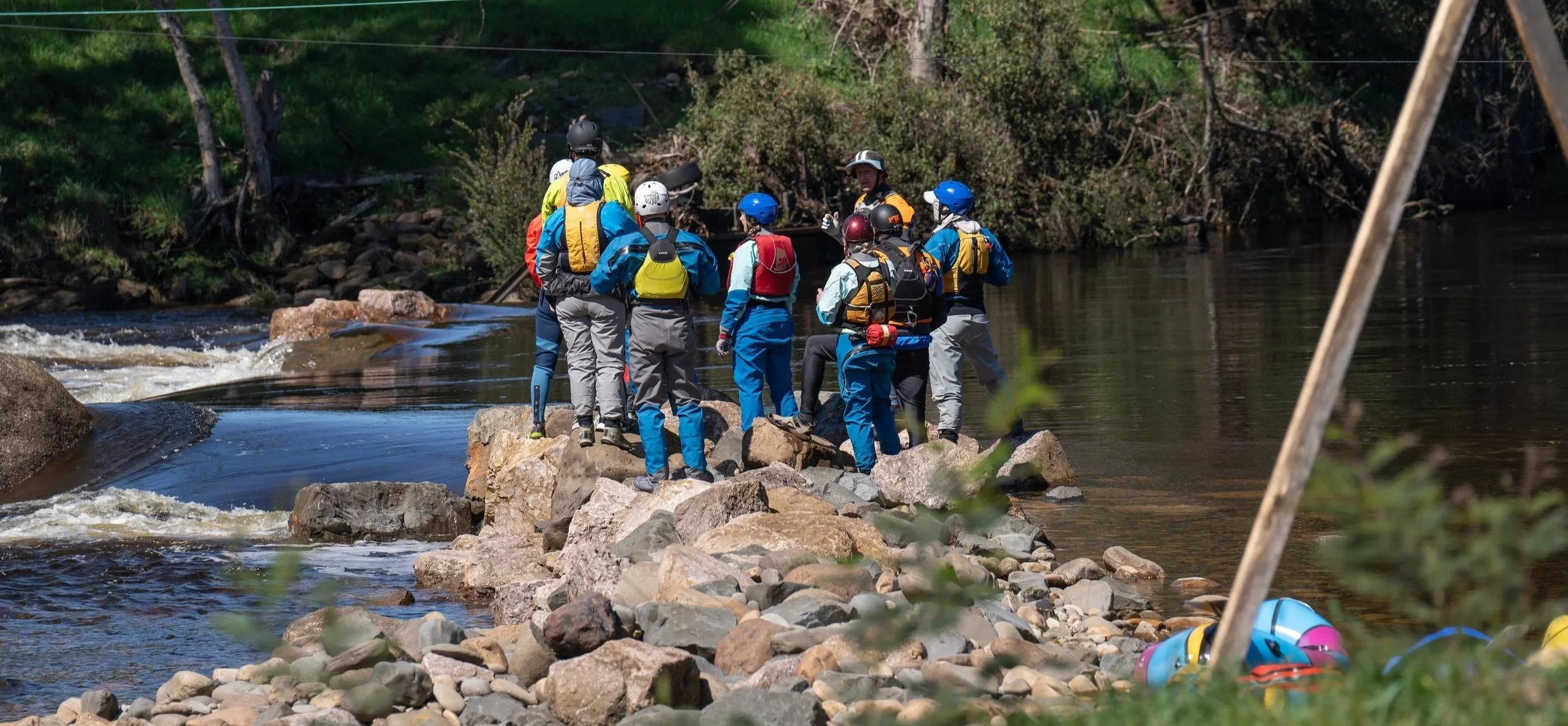
“You don’t know what you don’t know”
Intermediate Course
Gain the knowledge and skills that will help you negotiate whitewater safely and competently. This course gives you the confidence to tackle more complex grade 2 rapids and provides the foundation for grade 3 paddling.
Stepping up to an Intermediate Level
We are passionate about helping you to gain the skills and confidence to be able to safely manoeuvre yourself through more complex rapids. This course is for those who have mastered the fundamentals but who want to take their rivers trips to the next level. Learn how to build momentum to catch eddies and to cross swift currents. Gain an understanding of how to use edging and the design of packrafts to create carved turns. Learn to produce power through utilising good technical forward paddling technique.
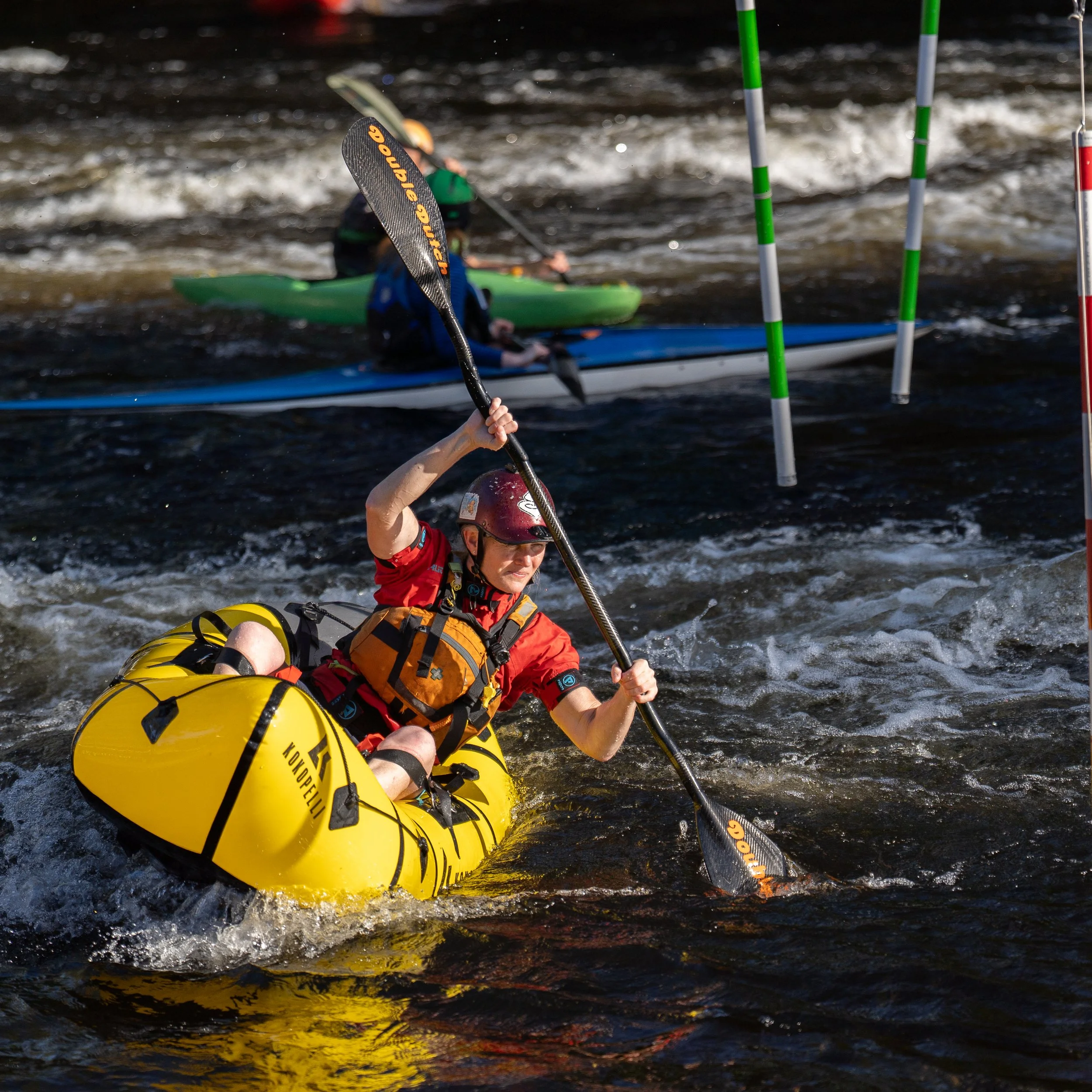
We teach packrafters to carve!
One of our key focuses is on teaching paddlers how to carve their packrafts. Learning to carve is a game changer! Carving allows you to smoothly enter and exit powerful eddies whilst avoiding the instability that many packrafters experience within the eddy zone.
Many packrafters turn through spinning their packraft on the spot or sliding across eddylines due to lack of edging. We aim to avoid these issues through teaching paddlers on both our Fundamentals & Intermediate Courses to adopt the basics for carving.
Who is it for?
It is ideally suited to those who have previously completed a beginner/fundamentals course and who currently paddle grade 2 rivers. It is perfect for those aspiring to learn to paddle grade 3 safely & competently. Even if you are already paddling down grade 3 rivers this course will teach how to get super comfortable and competent on more challenging whitewater.
The aim is for participants to learn the skills to competently get into and out of eddies, cross fast currents and manoeuvre around grade 2 rapids. Although the course will be conducted on grade 2 whitewater it is well suited to those aiming to achieve similar on grade 3 water. The best place to learn to get comfortable with grade 3 is on grade 2 whitewater through practising technical skills and hard moves on easy water.
Participants should already understand how to swim in whitewater in the event of a capsize and how to both throw and catch a throwbag. The focus of this course is on developing safety and technical knowledge specific to competently paddling packrafts on grade 2 whitewater however it will also include some basic rescue techniques as needed. Note that there will number of in-water practical components and hence all participants should be prepared for sessions involving capsizes and re-entries plus swimming and wading in moving water. Wetsuits are highly recommended or ideally drysuits, if available.
A water release has been booked with Hydro Tasmania for the weekend however there is always the chance that they are unable to release an appropriate volume of water. If this occurs we may need to potentially move aspects of the course to another river in the north or north west. Ideally this will be nearby and we will still camp beside the Forth River. For any other more significant changes participants will be notified by email.
Camping / Accommodation
The Forth Whitewater Course is owned and managed by the Tasmanian Canoe Club and includes excellent grassy campsites beside the river. There are basic toilet facilities and an undercover decked area however that is all. Friends/relatives of participants who are not undertaking the course are also welcome to camp although an additional fee of $10 pp per night is required for these people. Camping fees for participants is included in the course cost.
Participants need to supply all of their own camping gear including cooking gear, stove, tent, sleeping gear, etc. The nearest corner store/service station is 10 minutes away in Forth and larger shops about 20 minutes away. Phone reception is limited at the site however there may be some coverage up towards the road/toilets or near the shed and deck area. If you are flying in and need assistance with fuel for camping stoves, etc please let us know.
Alternatively, participants are welcome to stay off-site at their own expense. Note though that it is likely that we will spend 1-2 hours on the first evening analysing slow motion video. This session is optional.
Location Details
Drive south from the Forth township along the Wilmot Road approximately 8km. Look out on the left for a large sign next to a gate on a paddock that says ‘Tasmanian Canoe Club’. On Google Maps the location is listed as ‘Forth River Slalom Course’ and can be found on the following link:
https://goo.gl/maps/BkFspNpNw5Em6QXV8
Proposed Course Content
- Group Safety Considerations & Equipment
- River Communications
- Essential Technical Paddling Strokes initially on flatwater
- Then applying these Strokes on whitewater
- Creating Power
- Improving Edging
- Utilising Cross-Current Momentum to your Advantage
- Multiple Techniques for Entering and Exiting Eddies
- Achieving objectives through utilising Position, Angle, Speed, Head, Edging & Strokes
- Improving Stroke Efficiency
- Paddling a Pre-Defined Course
- Self and Assisted Rescues
- Scouting and Setting Safety
- Defensive and Aggressive Swimming in Moving Water
- Throwbagging Techniques and Practice
- Improvisation Techniques for Lost Paddles/Boats or Injured Paddler
- Practical Rescue Scenarios
- Paddling as a Team
Paddling Equipment List
Participants will need to provide and bring their own packraft and all personal paddling gear including a decent PFD, paddle and whitewater paddling helmet. It is highly recommended that all packrafts have thigh straps. As the water can start to be quite cold at this time of year, bring either a drysuit (recommended) or a decent wetsuit. Some participants who bring wetsuits choose to bring two so that they can swap a wet one out for a dry one. Decent footwear (sturdy and warm) is essential.
· Own packraft (ideally with thigh straps) with some form of attached bow and stern
perimeter lines · WW PFD (personal floatation device)
· WW kayak helmet (NOT a climbing or bike helmet)
· WW paddle
· Full wetsuit or drysuit or a ¾ wetsuit with drytop or cag
· Appropriate footwear for paddling and walking
· Drybag for carrying essential gear during trips
· Lightweight pack in case we need to walk into or out of a river
· Personal medications, sunscreen, etc
· Thermos or similar (optional)
Optional if available: throwbag, river knife, slings, carabiners, personal rescue gear, personalrepair equipment
If you need assistance with obtaining any equipment or have questions about the course or your suitability, please contact us!